
Liss Fenwick
Oceania – Presented by Antares Wells
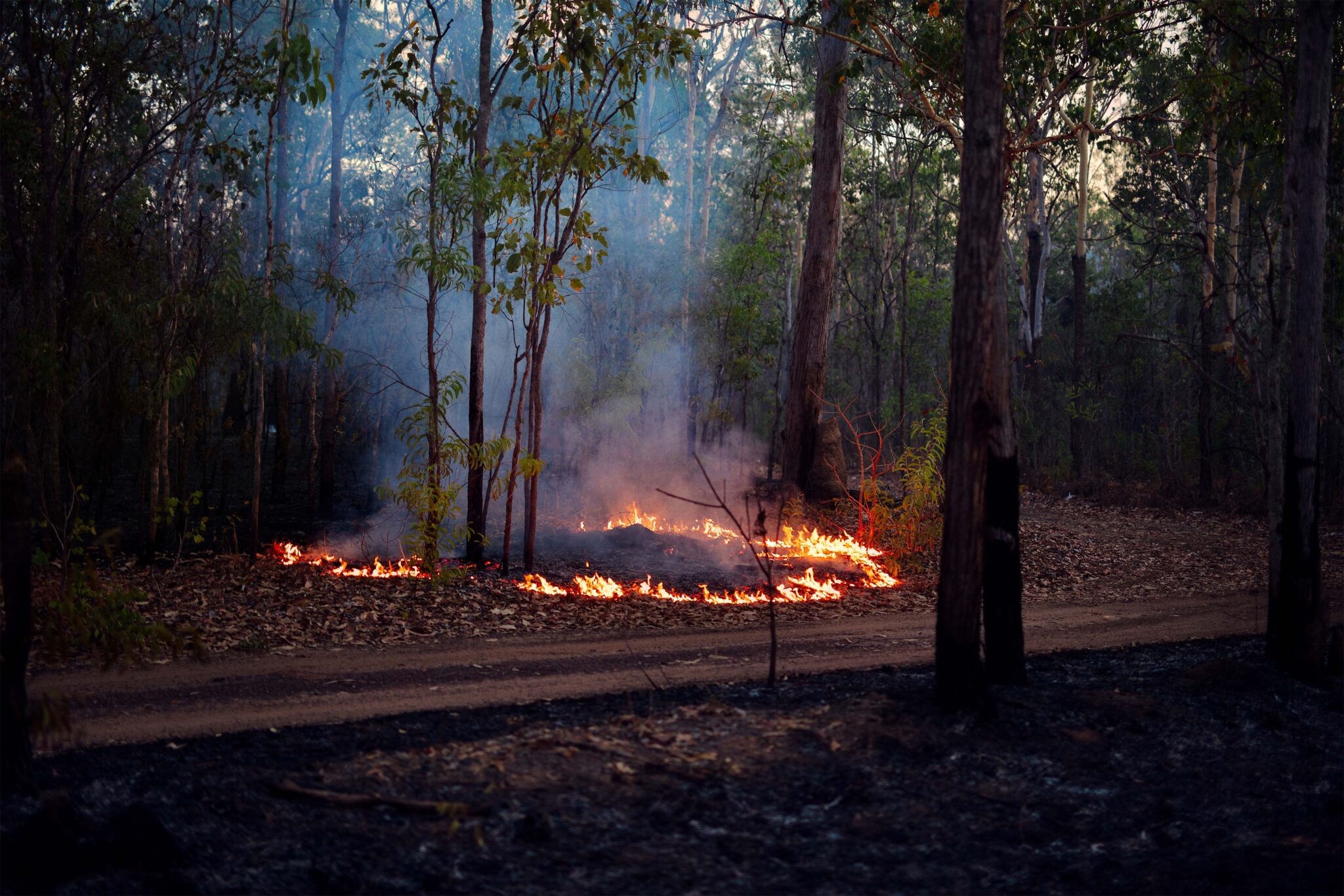
© Liss Fenwick, Humpty Doom
Statement
Humpty Doom spans two decades of work that began when the artist was a teenager and continued over twenty years, tracing three generations of her family in northern Australia, on Aboriginal land. The project intertwines family memory and colonial history within a landscape increasingly shaped by climate change and marked by tensions between Aboriginal Country, military infrastructure and industrial development. Fenwick challenges conventional landscape photography, which has often portrayed the environment as a passive stage for human activity or a resource to be exploited. Instead, she treats trees, termite mounds, pandanus palms, wetlands and insects as portrait subjects, active participants within a shared ecological drama. Her perspective is informed by the Aboriginal knowledge systems she encountered while living on Larrakia Country, which emphasise relationships to land rather than ownership of it. Humour, affection and unease coexist throughout the work, reflecting the contradictions of the Northern Territory, where extractive policies such as the ambition to “develop the north” persist even as the region becomes one of the most climate-vulnerable areas of Australia. Fenwick creates images that make room for complexity, grounded in lived experience while remaining open to speculative futures. Her work confronts ecological precarity while imagining other ways of relating to, remembering and caring for threatened landscapes.


Rather than presenting the savannah as backdrop, I treat its elements as protagonists: termite mounds lit like studio models and pandanus trees rendered monumental. This playful, stylised language disrupts stereotypes of the “rough rural town” while acknowledging the deeper ecological and colonial tensions that define the region. Humpty Doom is, ultimately, an attempt to see my home clearly at a time when its future is increasingly uncertain.

Liss Fenwick (Darwin, Australia, 1989) lives and works between Larrakia Country (Northern Territory) and Naarm (Victoria). Her practice engages photography, video, sound and material processes to examine the fragile entanglements between ecology, culture and colonial history, particularly in Australia’s tropical north, one of the nation’s fastest-warming regions and a place increasingly projected to become unsafe, even uninhabitable, under future climate conditions.
Fenwick’s work has been exhibited widely, including at the Centre for Contemporary Photography, MARS Gallery, and the Northern Centre for Contemporary Art. Her photobook Humpty Doom (Bad News Books, 2023) was shortlisted for the Aperture Paris Photo First Photobook Award and the Libraryman Award. Her work has been presented at major international festivals and institutions, including the Rencontres d’Arles and the Victoria and Albert Museum (V&A Museum). It has also been recognised through significant Australian art prizes, notably the Macquarie Emerging Art Prize and the Fineman Award.