
Barbara Cassin
Kosmos: A Greek Ecology?
Translation in English
Ecology has led to the invention of many words, in several languages, some easy to understand and translate, others not. Beginning with “ecology” itself: Ökologie, a fairly young German word, coined in 1866 by a biologist, Ernst Haeckel, a specialist in sponges and jellyfish, because “biology” seemed too restrictive to him. He was a Darwinian and probably thought that biology alone risked producing a Darwinism that was too narrow.
Oikos means “house” in Greek: the place where one is at home. Ecology, then, is the science of the house. Today it is obviously a political science. But then, “being at home” has always been a political question. Where does “home” begin and end? How, when, and under what conditions are we “at home”? Can we avoid being there as an “idiot”? In Greek, idios means “one’s own,” “private,” what belongs to a single person, as opposed to koinos, “common,” what is shared, what can form a community, and what is therefore truly political, like a polis, a “city.”
What, then, is the “home” of ecology? That is, at bottom, the whole question.
Our modernity took as its guide the self-evidence of a sentence by Descartes in the Discourse on Method, forgetting what it was opposed to, a dying scholasticism: “Instead of the speculative philosophy taught in the schools, one can find a practical one, by which, knowing the force and actions of fire, water, air, the stars, the heavens, and all the other bodies that surround us, as distinctly as we know the various trades of our artisans, we could employ them in the same way for all the uses to which they are suited…” and, above all, forgetting the as it were: “…and thus make ourselves, as it were, masters and possessors of nature.” Since then, mathematical physics has been the language the world speaks when it is useful to us.
Yet ecology seeks to think the world at least also in another language, and to rethink ourselves within another “nature,” by means of other “as it weres,” tied to other assumptions.
Listening to Greek, the Greek language, is perhaps not a relapse, as in Descartes’s day, into the old Sorbonne of “speculative philosophy” (which has probably become too difficult for us anyway…). The Greek word that spares us the self-evidence of mastery and ownership is kosmos. Its etymology is obscure, as Chantraine tells us (“derived in -mos or -smos, but from what?”), and it expresses the notion of order, of good order, in every sense, “material or moral.” It belongs as much to the vocabulary of “cosmology” as to that of “cosmetics.” The word invites travel, and one hears it echo in Baudelaire: “order and beauty,” which rightly opens onto “luxury, calm and voluptuousness”¹. It names the ordering of the world for a pagan, when not God but the gods are the dreamed-of double of reality. The opening sentence of the sophist Gorgias’s Encomium of Helen describes this whole organization:
“Order [kosmos] for a city is the excellence of its men; for the body, beauty; for the soul, wisdom; for a deed, merit; for speech, truth. Their opposite is disorder [akosmia]¹.”
There are landscapes and paths (I have walked some on Greek islands and in Corsica) where the world reorganizes itself at every turn into a new perfection, which the existence of the word kosmos invites us to perceive. Nothing, for me, illustrates kosmos better than the “Bird-Catcher Cup,” which unfolds like an ornament in cosmic calm: curving branches, birds in the cage of the world, and at the center the patient skill of the bird-catcher. All the kingdoms conspire (plant, animal, human) to make an order of the world: a home without an owner, won over by a single beauty that spaces them out and links them together. Why do we not say: cruel bird-catcher, who captures innocent birds to subdue them and trade in them? Probably because immanence reigns: everything is on the same plane, and each has found its place.
I would conclude as follows: perhaps the home must be imbued with beauty in order to be common?
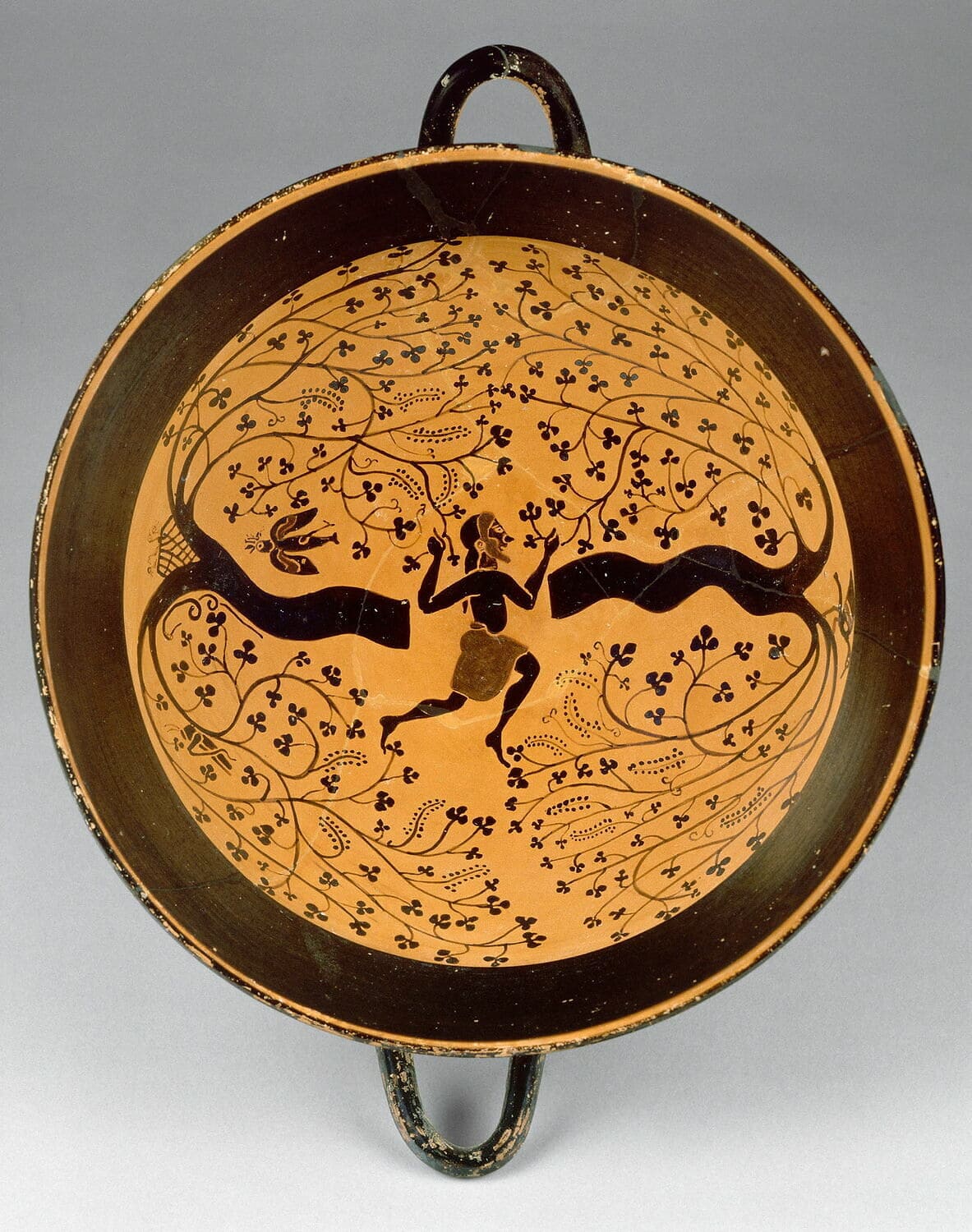
« Coupe de l’oiseleur », vers -550, Musée du Louvre © 1993 GrandPalaisRmn (musée du Louvre) / Hervé Lewandowski