Wara Vargas Lara
South America – Presentde by Andrea Josch
© Wara Vargas, Silent victims of the gold rush 2023
About the series
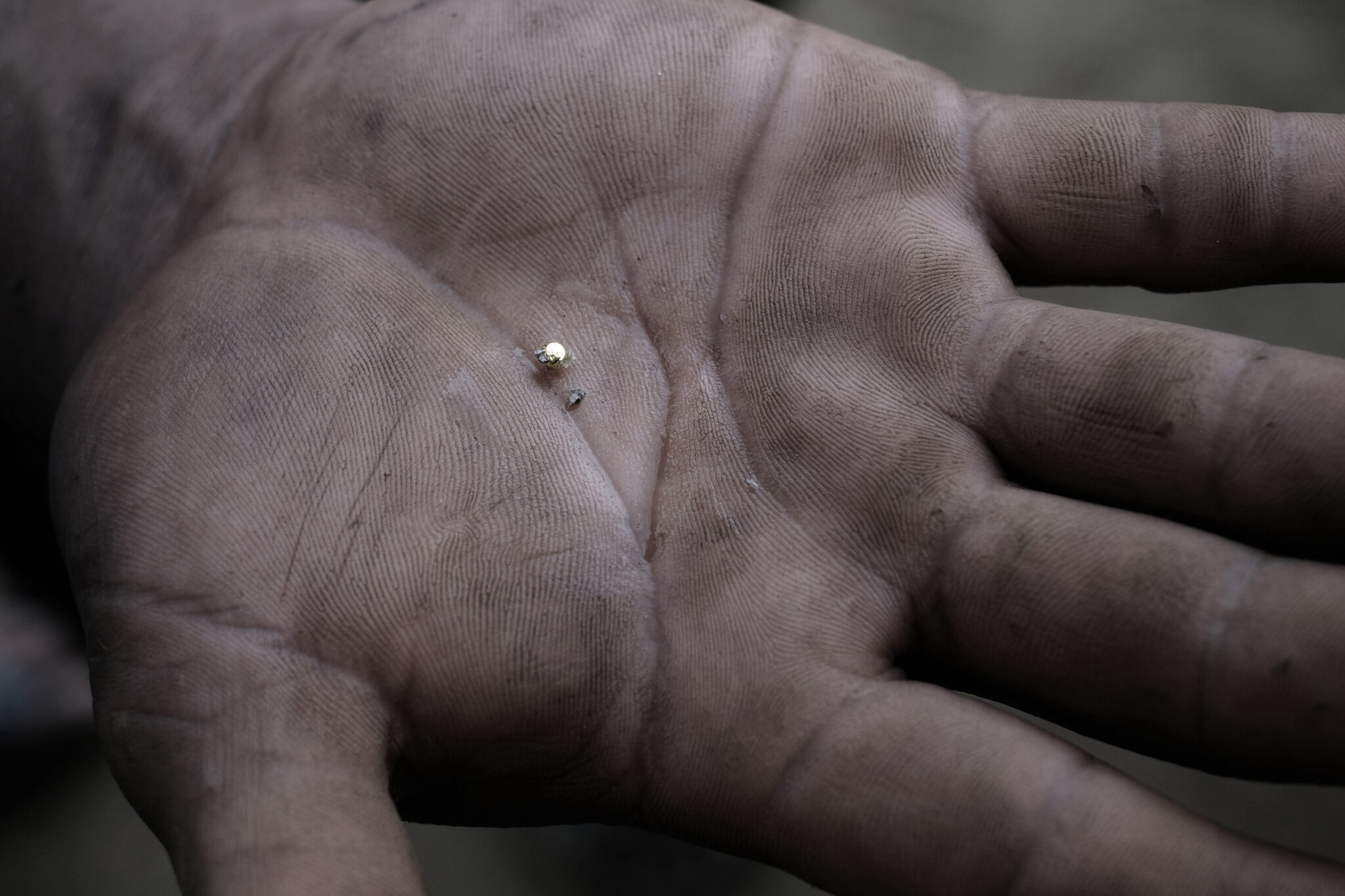
Silent Victims of the Gold Rush exposes the realities of gold mining in the Amazon, one of the most pressing environmental issues in Latin America. Indigenous women are among the most vulnerable. They handle mercury directly in washing pans to separate gold from ore, often without understanding the serious consequences for their own health and that of future generations. In the town of Guanay, located in the Amazon basin where the Mapiri and Tipuani rivers converge in the department of La Paz, the landscape is strikingly green. Home to 15,000 people, it is one of Bolivia’s most important gold-mining centres. The rainforest once dominated the area. Today, just a few kilometres away, the greenery has been replaced by heavy machinery, cleared land and polluted rivers. In the name of unchecked gold-mining development, humans are destroying the world’s largest rainforest. Although Bolivia is one of the 113 countries that signed the Minamata Convention, which prohibits the use of mercury in mining and other industries, it has failed to comply with the agreement. Mercury remains widely used in gold extraction, despite its severe environmental and health impacts. According to official statistics, Bolivia is the world’s largest importer of mercury. In 2020 alone, an estimated 100 tonnes of the toxic heavy metal were released into the country’s rivers as a result of mining activities. The United Nations has formally criticised Bolivia for its non-compliance with the Minamata Convention and for the continued environmental damage caused by mercury pollution.


I have always felt committed to social struggles, and even more so in recent years, because I feel that we are living in a time where image can be an instrument of change. Women in the Alacarani community are directly affected by gold extractivism. Across Indigenous territories in Latin America, we continue to live under colonialism disguised as modernity.

Wara Vargas Lara (Bolivia, 1977) is based in La Paz. Of Quechua heritage, she studied Communication Sciences and specialised in Press Photography at the José Martí International Journalism Institute in Cuba. Her work is deeply informed by questions of identity and the multiple histories that emerge from cultural and racial mixing. As both an artist and photojournalist, she explores the intersections of memory, Indigenous knowledge and social justice. For the past fifteen years, Vargas Lara has worked as a photojournalist for various media outlets in Bolivia. Through her photographic projects, she seeks to strengthen the cultural identity of Indigenous peoples, highlight the ancestral knowledge of women, and support communities affected by extractive industries. Her practice is also driven by a commitment to developing new visual narratives that challenge colonial perspectives and serve as tools for social change.
This dual commitment is rooted in her family history, shaped both by the influence of her father, the Bolivian activist and visual artist Mario Vargas Cuellar, and by the memories and teachings shared with her Quechua grandmother. Her documentary work has been exhibited throughout Bolivia and presented across Latin America, as well as in New York and Germany. Vargas Lara has published two books: Walls That Speak, which examines the dictatorship in Bolivia, and Makinmanta, a project documenting the Kallawaya culture through the stories of traditional midwives and grandmothers who have transmitted the knowledge of healing through plants and rituals across generations.