
Moe Suzuki
Asia – Presented by Marina Amada
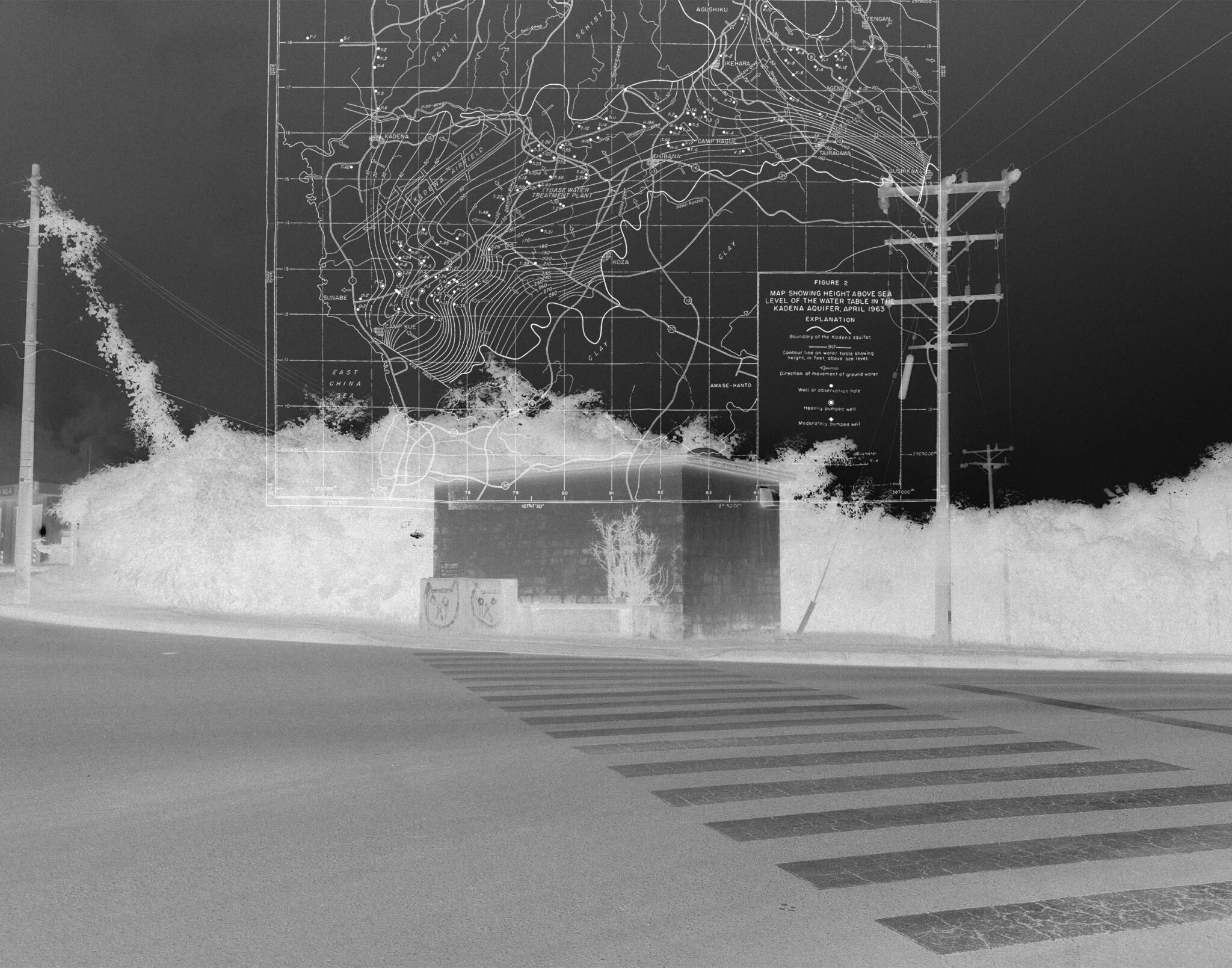
© Moe Suzuki, Aabuku
Statement
Aabuku is a visual narrative about the invisible contamination of Okinawa, Japan, by PFAS linked to US military bases, and the distrust it has generated among local communities. Through a creative process combining fieldwork, archival research and memory mapping of contaminated land, Aabuku inhabits the intersection of evidence and collective memory. Familiar yet unsettling scenes of everyday life, inverted landscapes that allude to suspected sources of contamination, and small drawn dots frame the invisible presence of PFAS as a form of slow violence, insidious and embedded in daily life. Following the Second World War, Okinawa was forced to host 70 per cent of US military bases in Japan. Investigations conducted by local authorities, together with sustained citizen mobilisation, established that the AFFF firefighting foam used on military bases contained PFAS at levels 600 times higher than regulatory standards. Many residents recall foam overflows during the 1980s, when children would play in it without knowing the risks. This contrast between the airy, cloud-like foam of childhood memories and the reality of its toxicity inspired the title Aabuku, an Okinawan word that refers to the bubbling appearance of foam. The contamination, publicly revealed in 2016, profoundly disrupted everyday life. Although the water intake supplying 450,000 people from Kadena Air Base was immediately shut down, PFAS concentrations in rivers, groundwater and soil have shown no measurable decline since. Aabuku extends beyond the specific issue of environmental contamination in Okinawa, connecting to the many communities around the world striving to protect their health and secure access to safe water.


Since my mother, who resides in Okinawa, told me that she stopped using tap water for cooking because of the contamination, my visual inquiry into this story began: collecting both personal stories of people who had taken this water for granted in daily life – eating, farming, playing, praying, learning – and evidence of this invisible contamination based on hydrogeology and toxicology research.

Moe Suzuki (Japan, 1984) studied photography at the London College of Communication, University of the Arts London. After returning to Tokyo in 2011, she taught herself the craft of bookbinding and began transforming her long-term documentary projects into hand-bound books. Working across photography, archival materials, research and illustration, she explores often invisible subjects: memory, the evolution of everyday life, and the changing landscapes inhabited by communities in the face of disability, environmental change and shifting social relationships.In her series Sokohi, Suzuki recounts her father’s gradual loss of sight.
The project received international recognition as an artist’s book after winning the Luma Rencontres Dummy Book Award 2021. Her photobook SOKOHI, published by Chose Commune, was selected by the Museum of Modern Art (MoMA) as one of its Favourite Photobooks of the Year in 2022. In 2024, Suzuki received both the Fujifilm GFX Challenge Global Grant Award and the Arttaca Grant for her latest project, Aabuku.